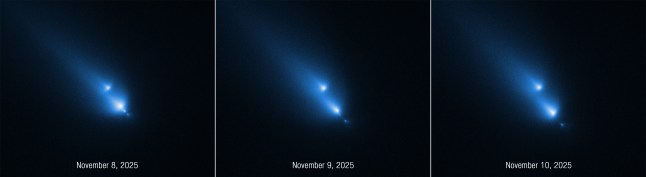
This series of images from NASA’s Hubble Space Telescope of the fragmenting comet C/2025 K1 (ATLAS) was taken over three days (Picture: NASA,ESA,Dennis Bodewits (AU)/Cover Images)
An interstellar comet that passed through the Solar System last year may be up to 12 billion years old – far older than the sun.
Scientists used the NASA/ESA/CSA James Webb Space Telescope to examine Comet 3I/ATLAS after it visited our galaxy in late 2025.
As the comet moved away,heat from the sun transformed its ancient ice into a glowing cloud of gas,allowing researchers to analyse its chemical composition in unprecedented detail.
The findings,published in the journal Nature on June 22,suggest the object originated in a distant planetary system during a period known as the Universe’s ‘cosmic noon’,when star formation across the galaxy was at its peak.
Researchers say the comet could have formed between 10 and 12 billion years ago,making it significantly older than the sun,which is around 4.5 billion years old.
Comet 3I/ATLAS is only the third confirmed interstellar comet ever detected. Its name reflects both its status as the third known visitor from beyond the Solar System and the NASA-funded ATLAS (Asteroid Terrestrial-impact Last Alert System) telescope that first spotted it.
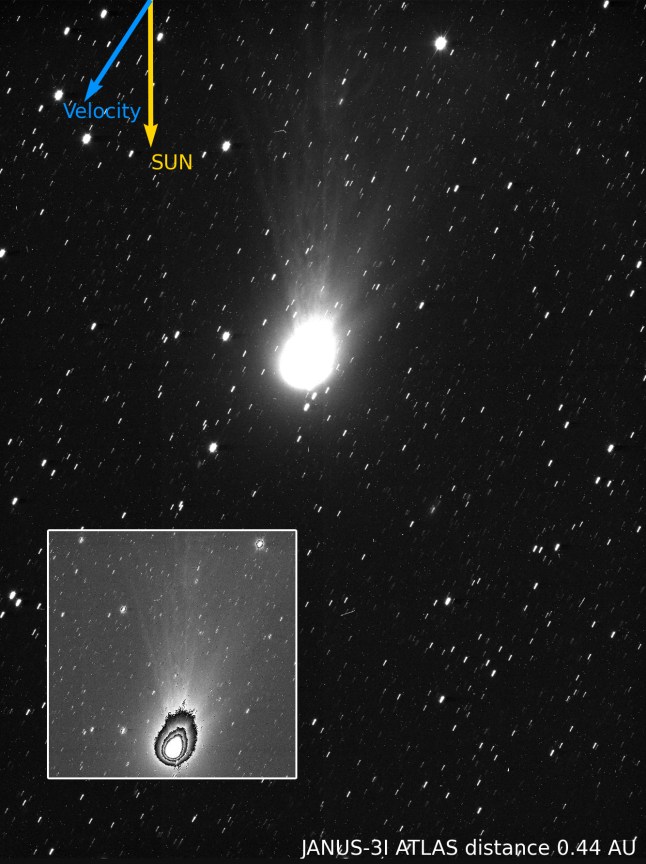
The Juice spacecraft’s view of 3I/ATLAS (Picture: NASA,Dennis Bodewits (AU)/Cover Images)
Using Webb’s Near-Infrared Spectrograph (NIRSpec),scientists measured chemical signatures unlike those seen in any known Solar System comet.
Among the most striking discoveries was an exceptionally high concentration of deuterium,a heavier form of hydrogen. The levels were around 30 times greater than those found in comets originating within the Solar System.
The researchers say this points to the comet having formed in an extremely cold environment early in the Milky Way’s history. The material that eventually became part of 3I/ATLAS appears to have remained deeply frozen for billions of years. The telescope also detected only trace amounts of carbon-13 compared with the lighter carbon-12 isotope.
Because galaxies gradually become enriched with carbon-13 as successive generations of stars live and die,the low levels found in the comet provide further evidence of its ancient origins.
‘This was a unique opportunity to study an ancient object from the distant Galaxy,probably pre-dating our sun and Solar System,’ said astro-chemist Martin Cordiner of NASA’s Goddard Space Flight Center and lead author of the study. ‘On the one hand,we get direct insight into that distant time and place,and on the other,we learn something about how unusual our own Solar System may be.’
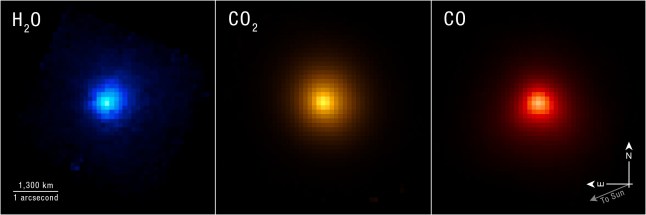
The James Webb Space Telescope can map specific chemical and molecular signatures,as seen here in its three images of comet 3I/ATLAS (Picture: NASA,Dennis Bodewits (AU)/Cover Images)
Astronomers from a range of disciplines collaborated to observe the comet during its brief journey through the Solar System. The team secured permission to interrupt Webb’s planned observing schedule in order to study the object. A separate study led by Cyrielle Opitom of the University of Edinburgh,using the European Southern Observatory’s Very Large Telescope,also examined the comet’s chemical makeup,focusing on forms of carbon and nitrogen contained in cyanide.
Scientists believe such observations could help answer broader questions about the origins of life in the Universe.
‘For us as scientists,finding these rare isotopes is fascinating,but the bigger picture here is looking at the possibilities of prebiotic chemistry elsewhere in the galaxy,’ said Stefanie Milam of NASA Goddard,a co-author of the study.
‘So far,we know of only one place in the vast cosmos where chemical ingredients led to life – our Solar System,our Earth. Analysis of these interstellar objects is a major step towards learning how common,or uncommon,the conditions for the evolution of life are in the Universe.’